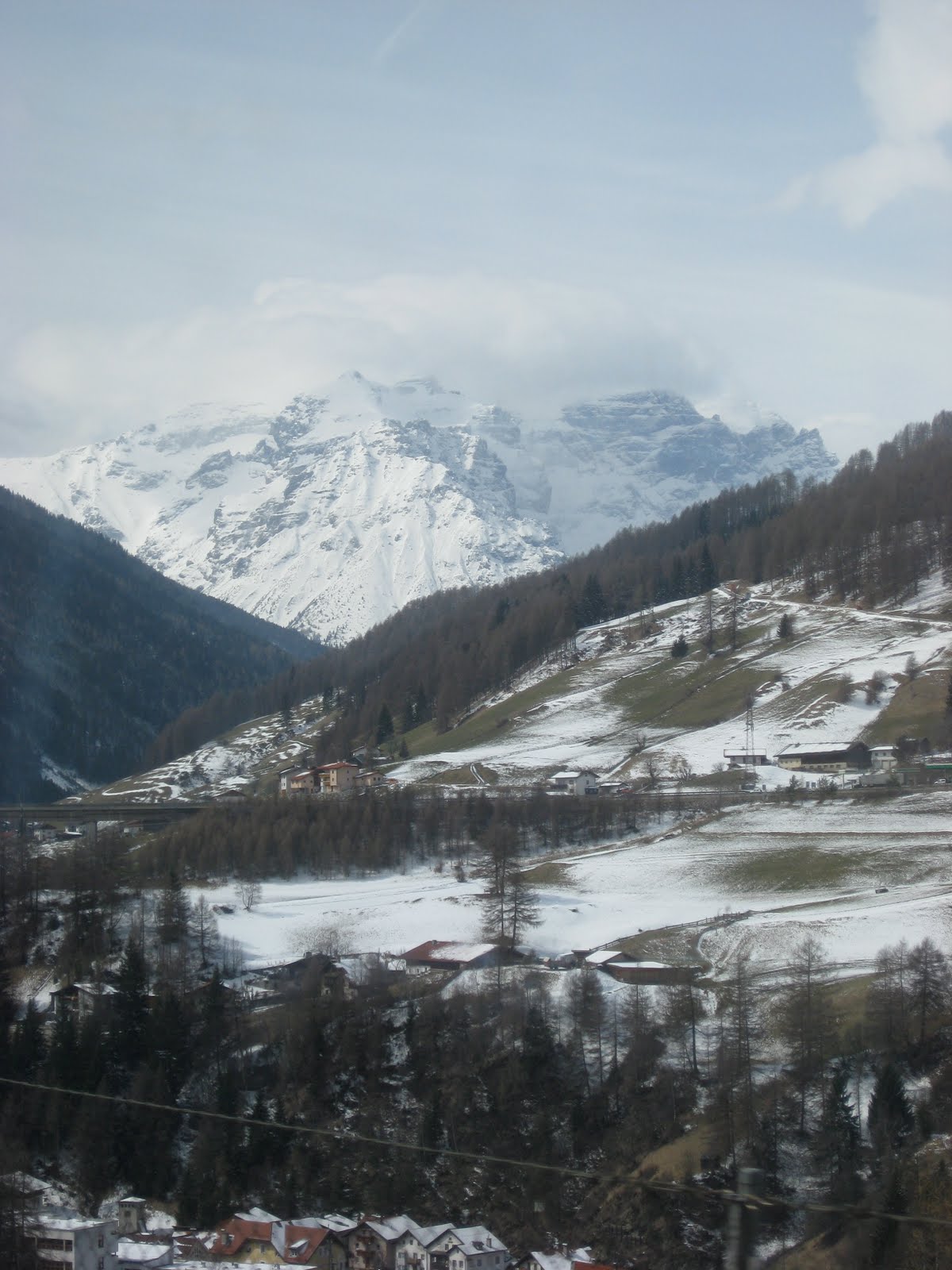
Although new technology greatly increased the speed with which one can cross the Alps, the route it follows through the mountains is very old. From Austria the route follows the Inn River (a tributary of the Danube) up the Wiptall (Wipp Valley). It crosses over Brenner Pass, the lowest Alpine pass, at only 1,370 meters above sea level (4,495 feet). It then joins the Adige River (which flows into the Adriatic Sea south of Venice) through the Eisack and Adige Valleys into Verona, at the base of the Alps. Brenner Pass has been an important mountain pass from even before the Romans arrived in the area, though in the 2nd century AD they completed the first road crossing the Pass. The Germanic Alamanni crossed the pass in AD 268 attempting to invade the Roman Empire, as did countless other peoples wishing to travel into Italy from the north.
Today, the railway more or less travels along the same paths that have been used for thousands of years, with the help of some modern innovations, namely 25 short tunnels (about 25 km in total) and 4 bridges. The rest of the way, the tracks follows the river up into the mountains, or out again. Humans have always relied on flowing water, either for trade or crop irrigation, or even to find the gentlest course between two places. Its no coincidence that almost every inland European city is located on a river. I have seen several rivers on this trip. Both Düsseldorf and Vaduz are situated along the Rhine. Munich sits along the Isar River, which flows into the Danube. Salzburg is on the Salzach River, which flows into the Danube via the Inn. The Danube is Europe’s second longest river, originating in the German Black Forest and flowing through Germany, Austria, Slovakia, Hungary, Croatia, Serbia, Romania, Bulgaria, and the Ukraine into the Black Sea near Milan and Turin are in the Po River basin along the Po River, Italy’s longest which joins the Adriatic near Venice. Zurich is along the Limmat River which flows into the Aar and eventually the Rhine.
Brenner Pass is a rough dividing line between Italian- and German-speakers, as well as between northern and southern European lifestyles. One can observe these differences simply by watching the landscape pass by as the train moves south. In Austria you see small farming villages centered around a church and settled in fertile valleys amongst the high, snow-capped peaks of the Alps. The fields stretch a little way up the sides of the mountains and are used to graze cows or else to grow wheat and barley. However once one passes over Brenner Pass, the landscape changes. The villages become more spread out, often based around large villa estates. Although there are still churches among the residential buildings, one also sees more small churches or monasteries located in the foothills of the Alps. In addition to wheat fields and orchards, which are located in the low valleys, one also sees the hills covered in grape vines and olive trees. Mediterranean Europe has long relied on the mountainsides to grow two of its most important crops, whereas in the north they were rarely of importance. The gradual change between German and Italian can be observed in the informational signs at the station. In Innsbruck everything is written in German and English. As you pass south, everything is in both German and Italian, and even the cities have names in both. The train passes through cities called Brennero/Brenner, Fleres/Pflersch, Funes/Villnöß, and Castelrotto/Kastelruth. By Verona, the signs were in Italian and English. There are also significant cultural differences between German-speakers and Italian-speakers, as I witnessed even in the very mundane atmosphere of the cafes. I had my lunch in the Austrian city of Innsbruck, and was served by a quiet, punctual waitress who spoke little, brought me my food, and left me alone. That night, I had dinner in a Pizzeria in Milan, and after being seated spent ten minutes talking to the staff before I even got my menu. The hostess asked if I spoke Spanish after she discovered that I don’t speak Italian, and the rest of the staff thought it would be funny to see how much Italian I could understand, and how much they could pretend to speak in Spanish. I was seated at the back, next to the table where the cooks and waiters were enjoying an espresso break, and they spent the next ten minutes talking to me, laughing, singing, and dancing. I eventually got my food, and ever later by bill, and left completely shocked at what had just happened. I have spent so much time in Northern Europe; I am forgetting my previous experiences in Spain and Italy. Nevertheless, I absolutely loved taking the train across the Alps, if for no other reason than it offers countless breathtaking views of this beautiful and snow-covered mountain range.