Showing posts with label Transportation. Show all posts

Tuesday, April 13, 2010

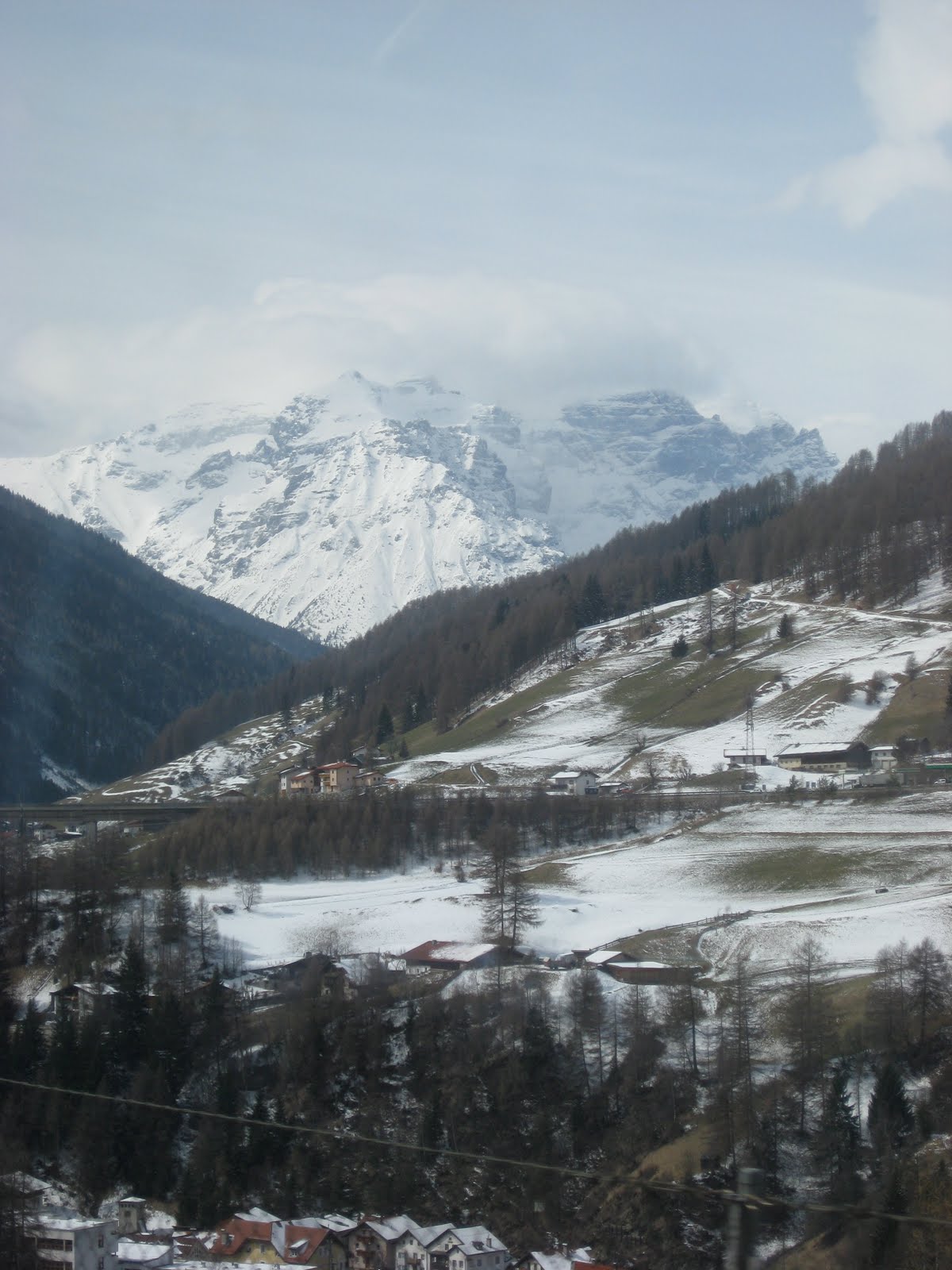
Crossing the Alps, Spring Break 5 of 10.


In the year 1794 James Watt patented the steam powered engine, which changed the transportation of goods and people forever. Within fifty years, all of industrialized Europe was establishing their own rail system. The railroad was an important investment economically, as it facilitated the rapid movement of consumer goods in the burgeoning market economies, but also politically, as rail-networks soon became important for defense of national borders. In 1859, The Austro-Hungarian Empire opened the first lines for what would eventually become the Brenner Railway, linking Austria with the Austro-Hungarian province of South Tirol (now part of northern Italy). The vast empire was committed to maintaining its borders south of the Alp Mountains, and when it was completed in 1867 it became the first railway to transverse the Alp Mountains; starting in Innsbruck, Austria and terminating in Verona, Italy.

Although new technology greatly increased the speed with which one can cross the Alps, the route it follows through the mountains is very old. From Austria the route follows the Inn River (a tributary of the Danube) up the Wiptall (Wipp Valley). It crosses over Brenner Pass, the lowest Alpine pass, at only 1,370 meters above sea level (4,495 feet). It then joins the Adige River (which flows into the Adriatic Sea south of Venice) through the Eisack and Adige Valleys into Verona, at the base of the Alps. Brenner Pass has been an important mountain pass from even before the Romans arrived in the area, though in the 2nd century AD they completed the first road crossing the Pass. The Germanic Alamanni crossed the pass in AD 268 attempting to invade the Roman Empire, as did countless other peoples wishing to travel into Italy from the north.

Today, the railway more or less travels along the same paths that have been used for thousands of years, with the help of some modern innovations, namely 25 short tunnels (about 25 km in total) and 4 bridges. The rest of the way, the tracks follows the river up into the mountains, or out again. Humans have always relied on flowing water, either for trade or crop irrigation, or even to find the gentlest course between two places. Its no coincidence that almost every inland European city is located on a river. I have seen several rivers on this trip. Both Düsseldorf and Vaduz are situated along the Rhine. Munich sits along the Isar River, which flows into the Danube. Salzburg is on the Salzach River, which flows into the Danube via the Inn. The Danube is Europe’s second longest river, originating in the German Black Forest and flowing through Germany, Austria, Slovakia, Hungary, Croatia, Serbia, Romania, Bulgaria, and the Ukraine into the Black Sea near Milan and Turin are in the Po River basin along the Po River, Italy’s longest which joins the Adriatic near Venice. Zurich is along the Limmat River which flows into the Aar and eventually the Rhine.

Brenner Pass is a rough dividing line between Italian- and German-speakers, as well as between northern and southern European lifestyles. One can observe these differences simply by watching the landscape pass by as the train moves south. In Austria you see small farming villages centered around a church and settled in fertile valleys amongst the high, snow-capped peaks of the Alps. The fields stretch a little way up the sides of the mountains and are used to graze cows or else to grow wheat and barley. However once one passes over Brenner Pass, the landscape changes. The villages become more spread out, often based around large villa estates. Although there are still churches among the residential buildings, one also sees more small churches or monasteries located in the foothills of the Alps. In addition to wheat fields and orchards, which are located in the low valleys, one also sees the hills covered in grape vines and olive trees. Mediterranean Europe has long relied on the mountainsides to grow two of its most important crops, whereas in the north they were rarely of importance. The gradual change between German and Italian can be observed in the informational signs at the station. In Innsbruck everything is written in German and English. As you pass south, everything is in both German and Italian, and even the cities have names in both. The train passes through cities called Brennero/Brenner, Fleres/Pflersch, Funes/Villnöß, and Castelrotto/Kastelruth. By Verona, the signs were in Italian and English. There are also significant cultural differences between German-speakers and Italian-speakers, as I witnessed even in the very mundane atmosphere of the cafes. I had my lunch in the Austrian city of Innsbruck, and was served by a quiet, punctual waitress who spoke little, brought me my food, and left me alone. That night, I had dinner in a Pizzeria in Milan, and after being seated spent ten minutes talking to the staff before I even got my menu. The hostess asked if I spoke Spanish after she discovered that I don’t speak Italian, and the rest of the staff thought it would be funny to see how much Italian I could understand, and how much they could pretend to speak in Spanish. I was seated at the back, next to the table where the cooks and waiters were enjoying an espresso break, and they spent the next ten minutes talking to me, laughing, singing, and dancing. I eventually got my food, and ever later by bill, and left completely shocked at what had just happened. I have spent so much time in Northern Europe; I am forgetting my previous experiences in Spain and Italy. Nevertheless, I absolutely loved taking the train across the Alps, if for no other reason than it offers countless breathtaking views of this beautiful and snow-covered mountain range.

Saturday, October 31, 2009

Transportation: Bikes, Part Two

Sorry for the lack of posts these 1st few weeks. It was midterms time here and Denmark, and consequently we have all been busy with papers and exams. In the end, we all survived, and we now have our two-week travel break. We are all free to travel Europe for two weeks, before returning to Copenhagen for the last part of the semester. I will be going to Russia the first week with a DIS sponsored optional study tour, and then I will be going to Seville, Spain on my own to explore. I wont have my computer in Russia, or perhaps Spain, so the blog is going to be pretty inactive for the next few weeks. Needless to say, I will be posting about my experiences in Russia and Spain just as soon as I can.

For the time being, however, I wanted to post a couple of YouTube videos of Copenhagen. The first is a travel video from 1953, showing what Copenhagen looked like fifty years ago. Some of it still looks similar today, while other things have changed quite a bit. Just a note on the video, it was made in the 1950’s and consequently is not subject to the same cultural sensitivity we are accustomed to today. Also, the narrator says Copenhagen very strangely.

The second video is about bikes in modern Copenhagen. They really do deliver the mail via bicycle, its wonderful.

I will be back in Denmark on the 14th of November, so check back then for a barrage of new blog-posts.

Thursday, October 22, 2009

Transportation: S-Trains

The main ‘subway’ system in Copenhagen is called the S-Tog (or S-Train) system, and is basically like the metro/light-rail/subway you would find in any other city. Although most of the trains run exclusively above-ground, they are the primary public mode of transportation used by everyday Danes and commuters. There is also an underground train system called the metro, but I will reserve discussion on that for a later post. There are seven different lines, each with a number and color, which run from the north, west, and south of Copenhagen into the city center.

While all of this is pretty standard for a modern European city, what I find most interesting is the culture of the trains, and the public transportation system in general. One of the first things I heard about the trains is that people don’t talk on them. I assumed they would be pretty quite, but once I got here, I found out it is really true. In Denver, the trains are pretty quite when there is no one on them. But when they are full, they can be pretty loud. Here, during the daytime, especially during the peak commuting hours, the trains are practically dead silent, even when they are packed with people. I will admit that sometimes, especially when some of the teens are on their way home from a night of drinking, it can be pretty loud. But I would have to say, in general, they are not. It is actually somewhat unsettling. I usually put on my iPod so that it doesn’t bother me. Its hard to describe the feeling really, but if you ever actually experience it, I think you will understand what I mean.

Some other interesting details...You can take a bike, and a dog, but it costs a little extra. It is also tolerated for you to be drinking on the trains. It is actually somewhat sad to see old men having a beer at ten in the morning, but no one seems to mind.

Here are some photos I have taken of the S-Trains, so you know how nice they are.


Thursday, September 24, 2009

Transportation: Bikes

This blog entry is the first in my series on different means of transportation in Denmark. One of the first things I remember seeing when I arrived in Denmark was that there were a lot of people on bicycles. The more time I spent here, the more I noticed that bicycles are absolutely everywhere. There are more than four million bicycles in Denmark, which means on average 83% of Danes own a bicycle. In Denmark, 20% of commuters travel in bicycles, compared to less than one percent in the United States.

Apart from riding bicycles much more, Danes also seem to be more talented on bicycles than Americans are. They ride at high speeds, right next to cars, busses, and trucks, without helmets, and are often holding something in one of their hands. I have seen bicyclists holding flowers, smoking, talking on the phone, holding an umbrella, drinking coffee, and even carrying a painted canvas once, without any problem at all. It is really incredible.

They also have what are called “Christiania Bikes.” They are named after Christiania here in Copenhagen. You can read about it in my post here. They were first made for people in Christiania who wanted to transport materials to build houses from recycles materials. However, they are now very popular all over Copenhagen from transposing groceries, building materials, and even ones children. I am told that Frederik, the Crown Prince of Denmark, takes his two young children to kindergarten everyday in a Christiania Bike. Here is a Christiania Bike designed for transporting children.

Here are some more photos to show you just how many bikes there are. You see them everywhere.


Additionally, bike locks work differently here. When I first saw all the bikes, I thought that none of them were locked up. I soon learned that it is unnecessary to lock bikes to something; rather the lock just prevents the back wheel from moving, as there is a bar across it. This means that you can pick up a locked bike and carry it away, you just cannot ride it. Unfortunately, bike theft is a problem here, and every hour about eight bikes are stolen. However, if the bike had an approved bike lock on it, insurance will replace the bike for you. There is also a new program that is beginning to be implemented which allows you to have a location device on your bike, so that it can be located if it is stolen.

Fortunately, my bike has not been stolen, although it has already happened to a few DIS students. However, from what I have heard, this was due to the fact to not using the proper bike-locks. I ride my bike about three miles every day, to and from the train station. However, this is nothing compared to my host father, who rides more than 16 miles everyday to get to and from his job in a neighboring town.

Overall, bikes are a major part of life here in Copenhagen. Most of the major streets have bike lanes, as well as traffic lights for the bikes. Many of the traffic signals in Copenhagen are actually timed for bicyclists, not for cars, so that if a bicycle were to hit one green light, he would hit all of the others. If you are ever driving in Copenhagen, you have to know that bikes have the right of way, followed by pedestrians. And if you are ever walking in Copenhagen, you had better watch out, because the bikes really aren’t going to stop for you.