Today, my Danish Language professor took us to see the Freetown of Christiania (Fristaden Christiania) here in Copenhagen. For those of you who don’t know about Christiania, here is a short description. In the 17th century, he Kingdom of Denmark established a series of military ramparts and defenses in the town of Christianshavn, across the harbor from Denmark. They were re-fortified and utilized by the Danish military for several centuries. By the 19th century, Christiania became an important producer of cannon balls and gun powder for the Danish navy, but after WWII, these supplies were essentially obsolete, and the military base was abandoned by 1971. In that year, a group of youths and other individuals who were having difficulties affording accommodation in Copenhagen broke into the barracks, and occupied them as squatters. Over the following years, members of many “unconventional” groups began to move to the area, including hippies, collectivists, and anarchists. The original mission statement of the community states that “[t]he objective of Christiania is to create a self-governing society whereby each and every individual holds themselves responsible over the wellbeing of the entire community. Our society is to be economically self-sustaining and, as such, our aspiration is to be steadfast in our conviction that psychological and physical destitution can be averted.” The freestate was essentially granted semi-autonomy by the Danish government, and until recently, has been a fairly peaceful community within Copenhagen.
Nevertheless, it is not without its problems. Although Chrisiania common-law states that hard drugs are prohibited, it has had problems with heroin and other drug users and dealers within its borders. Additionally, it is continually in conflict with the Danish government, especially since 2001, when a center-right government came into power. Many far right Danish politicians would like to see the community destroyed, while many leftist politicians value the fact that it offers an alternative way of life for those who wish to live it. The Danish police have recently attempted to crackdown on marijuana sales in Christiania (which are legal according to Christiania common law). This has caused a gang war between Danish Hell’s Angels, and second-generation immigrant gangs in Denmark, which has brought violence to Christiania, as well as other neighborhoods in Denmark. Biker gangs used to reside within Christiania, but they were thrown out by its residents after bringing the body of a murdered immigrant back to the community, and attempted to hide it there. Many were arrested by the police, and the rest were forced to leave for violating the law against violence.
Christiania, as I saw it today, is indeed a very interesting place. We had a guided tour by one of the spokes persons, and were able to see some of what life it like for the community. She explained how the residents of Christiania are tax-paying citizens of the Danish Kingdom who chose to live in a kommune (Danish for municipality, I live in Hillerød Kommune) which operates in a different manner that the other municipalities of Denmark. Christiania is divided into a series of smaller communities, each of which is self governed by a democratic council in which everyone participates. Some operate as “socialist” communes, while others do not. All community-members also participate in the Christiania-wide council, which addresses the needs of the community as a whole, such as sewage, garbage, street paving, and electricity. The residents of Christiania live in old military barracks, other building, as well as in homes that have built themselves (of recycled materials from the rest of Copenhagen). Nevertheless, all of the residents pay the same rent to the community, regardless of what kind of home they live in. The homes are allocated by the residents, and are given to people in terms of what kind of accommodations they need, the larger homes going to families with more children. Residents also have the option of building their own homes out of recycled materials that they can buy at a store in Christiania. They still have to pay rent on it though, just like everyone else. Residents can buy their groceries and other food items at stores in Christiania, which also has several restaurants, bars, cafes, art shops, and even one that sells restored wood-burning ovens. Overall, there are about 700 adult residents of Christiania, half of which work in Copenhagen. There are also about 250 children, who go to school in the public schools in Copenhagen, with after-school care in Christiania. Many residents work in Christiania itself, and are paid 1 løn per hour. The løn is a currency minted by the community in Christiania, and is worth 50 Danish kroner. The wage of 1 løn/50 kroner per hour is equal to about ten American dollars. Supprising, this is below Denmark’s lowest market wage, which is about 110 kroner ($22) per hour. However, as they do not have to pay large taxes to their local kommune, this wage is sufficient.
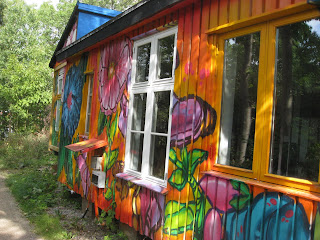
Here are some photos of what I saw in Christiania. They are primarily of the residential area, as photographs are prohibited in the main market. The ‘legal’ marijuana pushers do not want the police to have photographs circulated of them selling drugs, nor do the people want to be photographed purchasing marijuana.
There are a lot of very neat homes in Christiania, many of them built from scratch by their residents with recycled materials…
 There is also a newly painted Tibetan Buddhist Stupa.
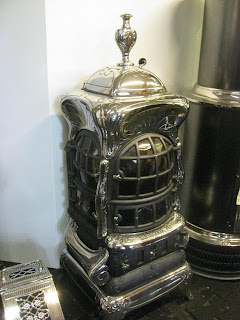
 As well as some very beautiful antique wood-burning stoves, which the residents can buy for their homes.
Overall, it was a very interesting field-trip. I learned a lot about Christiania, as well as about Denmark in general. I hope you all have a chance to visit Christiania someday, especially before the government has the chance to take it down.