Sunday, January 31, 2010

London

I have delayed writing post about London itself for quite a while now, as there was so much that loved in London, I don’t really know where to start. London is probably one of the best cities I have ever visited, and is very high-up on my list of favorite places. Its charm is manifold, but in short, London offers the following appeal. It’s huge. It’s a city of well over seven million people, very densely packed into one place. Not only that, it is extremely diverse. It is a place where people of the most disparate backgrounds live and work together. According to one survey, over 300 different languages are spoken by its inhabitants, whose religious professions range from Christian, Muslim, Hindu, Jewish, Sikh, Buddhist, and atheist, as well as a fair number of others. As many as 15% of Londoners were born outside of the UK, making it a place where you can encounter almost any variety of person. On top of this, the city is almost 2,000 years old, and the reminders of its history are everywhere. In architecture alone, you can see Norman buildings, Gothic buildings, Renaissance buildings, Georgian and Victorian buildings, as well as fantastically modern buildings. In short, it was fantastic, and it very much satisfied the anglophile inside me.

Here are some photos of all the amazing things I saw. I took the embarrassingly large quantity of 500 photos of London alone, so I had a hard time narrowing it down to these few. If you are ever curious to see the rest, feel free to ask me next time you see me. Or better yet, visit London if you can, because it is fantastic.

Westminster Abbey

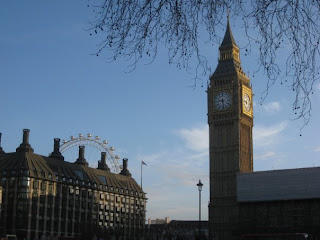
Big Ben and the London Eye
Inside the reconstructed Globe Theater of Shakespeare

Along Fleet Street

St. Paul's Cathedral as seen from the Millennium Bridge

Trafalgar Square

St James's Park
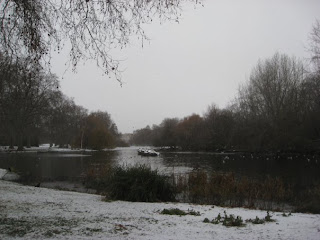
Hyde Park

Buckingham Palace Gates

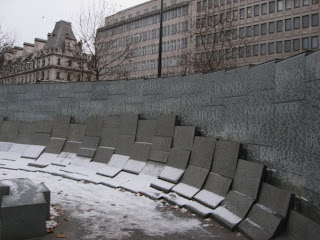
A War Memorial
London Bridge
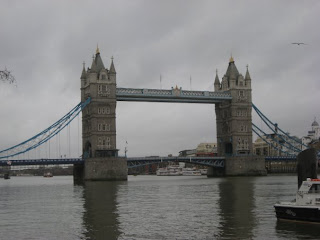
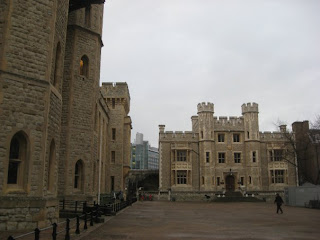
Tower of London
Piccadilly Circus at night

Platform Nine-and-three-quarters, at King's Cross Station

"The Gherkin"

The Sherlock Holmes Museum, at 221b Baker Street

And finally the once home of our friend Friedrich Engels

Sunday, January 17, 2010

Oxford

On my last full day in England, I decided to visit the city of Oxford, which is best known for its University. It is one of the oldest universities in the world, known to have existed in some form in the year 1096 CE. It is made up of 38 Colleges, each with its own history, cathedral/chapel, and residential and dining halls. Some of the more famous include Christ Church, Corpus Christi, and Magdalen. It is an amazing complex of incredible buildings and history.

The town itself is also very old, and was first occupied in Saxon times. It has many old buildings not associated with the university, as well as great museums and other cultural attractions. I had a great time visiting Oxford, and I am very jealous of my friends who have studied there, if for no other reason that it is extremely beautiful, and has so much history.

Stonehenge, Salisbury, and Bath

The United Nations Educational, Scientific, and Cultural Organization (UNESCO) has created a list of some of the most spectacular and significant places and buildings, known as World Heritage Sites. I have made it my goal in life to see as many of them as I can. While in England, I got the chance to see four of them. I took a tour to the southwestern English countryside to see Stonehenge, and the City of Bath.

Our first stop was the Stonehenge Monument, which was built is several stages between 3,100 BCE and 1,930 BCE. It is one of the most recognizable Neolithic stone constructions, as well as one of the most controversial. Everyone has their own idea about what Stonehenge was, and who built it. All that being said, it was totally worth a visit, no matter how touristy it may be. I loved seeing the stones, it was very special.

Next we visited the Cathedral of Salisbury, which was built between 1220-1320 CE. It is an amazing church, which is currently being restored. It contains the oldest working clock in the world. It also houses one of the five remaining copies of the Magna Carta.

Finally, we got to the City of Bath, which is also a UNESCO World Heritage Site. It houses a natural hot spring, the waters of which have been thought to be magical and curative since before the Romans. The Romans built what is essentially a sauna there, as well as a temple. Then, in the Victorian Era, it became a resort town for the Royal Court. The nobility flocked to Bath to ‘Take the Waters’ in hopes of healing any number of ailments. Today you can still take the waters for 50p, which was an interesting experience. It is strangely warm, salty, and sulfurous. I think the best that can be said is that I didn’t get sick from it. It is a great city, full of Georgian and Victorian architecture, as well as an impressive church of its own. It was a great day outside of London, and a wonderful chance to see some of the English countryside, which is beautiful when covered in snow.

Taking the Waters

The River Avon

Friday, January 8, 2010

"There’s No Place Like London"

I have officially started my second short holiday of the winter season, this time in London, England. I was in Berlin, Germany last week with my parents, and I will be posting photos from that trip just as soon as I am back in Denmark. For now, I would like to keep you all filled in on my trip here in England. I will try to write as often as I can, but if I don’t, I will post everything at the end of the trip, next Friday.

This is the first time since august since I have been in a country where the ‘official’ language is English. I wasn’t sure how I would feel about it, and now that I am here, I still don’t. In fact, I’ve heard very little of the ‘Queen’s English’ since I got here. Sure, all of the signs are in English first, but still multiculturalism is all around me. When I arrived, I waited in the customs line with a group of Mandarin-speaking Chinese tourists. On the train, I was next to a group of Turks. I went out to what I thought was an Italian cafĂ© for dinner, only to find the television was playing Croatian News and it is frequented by Frenchmen and Russians (or other Slavic-speakers, I wasn’t exactly sure). It is absolutely incredible how many different languages you hear here in London, and this has only been the first few hours.

I have also learned that you have to look the other way when crossing the street, as they drive on the left side of the road here. Somehow I forgot that in all the confusion of arriving in a city of over seven million people (more than ALL of Denmark). Thankfully however, in my neighborhood, instructions to look left or right are painted on the sidewalks, so I was saved from making any mistakes.

I’ll keep this blog short at I am planning on getting an early start to my sightseeing tomorrow morning. I will be sure to fill you all in on my adventures here just as soon as I can. Thankfully, I have wireless at my hotel, so it shouldn’t be too much of a problem. Until then…Cheers!

Wednesday, January 6, 2010

Jutland Adventures

My family and I have finished our trip to the mainland peninsula, and we have seen quite a bit. Our only stop on the first night was to Koldinghus, an old palace in the town of Kolding. I previously visited the palace, with DIS and you can read my post about it here. However, this time it was decorated for Christmas. In the former dining hall, there was a large Christmas tree decorated with children’s paper ornaments.

The next morning we went to the small town of Jelling, which is the burial place of the first King of all Denmark, Gorm the Old. Gorm was originally buried in a Viking style burial mound, with many grave goods and even a stone ship. However, his son Harald Bluetooth moved him into a church next to the mound. Harald was the king who converted to Christianity. There is a very old stone church where Gorm is buried, and also a large rune-stone commissioned by Harad honoring his father. This stone also bears the first known representation of Christ in Scandinavia.

Gorm's Mound

Rune Stones

A Modern Version

Jelling Church

Our next stop was the small village of Stadil, on the west coast of Denmark. Stadil is the village where my great-grandmother lived before she immigrated to the United States with her parents. We visited the old family farm, Stougaard, as well as the Stadil Church.

Stougaard Farm

Stadil Church

Next, we made our way south along the coast, and stopped near the town of Hvide Sande to look at the North Sea.

Finally, we arrived in Ribe, which is the oldest town in Denmark. It was originally settles in… We saw the Ribe Cathedral, which is very beautiful, even from the outside.

Overall, it was a successful journey to Jutland. We saw a lot, but learned that there was even more we didn’t see. A lot was closed because of the holidays and the winter, which is not peak tourist season. Nevertheless, we saw a lot of very interesting things, many of them hundreds of years old. It is incredible how much happened there so many years ago, and how much of it remains today for visitors like us to see and enjoy.

Christmas Eve in Denmark

As you know, my parent came to visit me this Christmas, and we celebrate Christmas Eve with my Danish Host Family. Christmas in Denmark is about three things; food, a Christmas tree, and gifts. Every Christmas, Danes sit down with their family’s and eat more or less the same thing. For meat, they have roast duck with prune and apple stuffing, and fleskesteg (roast pork with cringing). They also have normal boiled potatoes with gravy, sugar coated brown potatoes, and red-cabbage. After that, we have a very special ris a’lamande, or rice pudding with almond pieces, and cherry sauce. However, inside the pudding, there is one whole almond. Every Christmas, the person who manages to find the whole almond without eating it gets an extra gift. It took a while to work our way through the pudding, but in the end the almond was found. At the very least, this is a tradition that insures that all the pudding gets eaten, whether the guests really like it or not.

After dinner, and the first round of dishes are done, we move on to the Christmas tree. The Danish Christmas tree is decorating with ornaments, raffia, and lit candles. All the lights are extinguished, and everyone joins hands, rings Christmas carols, and dances around the tree. One can’t help but think of the pre-Christian Scandinavians who did the same thing with their juletræ over a thousand years ago. Although it was a little awkward not knowing the words to the carols, we got by humming along, and I at least enjoyed it very much.

Finally it was time to open the presents, accompanied by coffee, tea, and the Danish Christmas cookies. Danes generally try to open one present at a time, with everyone reading out who it is and what it is from, but in the end it generally ends up a little more chaotic, as it would take hours otherwise. As far as I can tell, Danes are one of the only countries to open their presents on Christmas eve, and not Christmas day. Christmas day is a time to celebrate with other relatives or friends, or even to go see a recently released film. It is still a national holiday, as is they day after it (aptly called Second Christmas Day), and it is a time to relax at home with friends and family. I think we all enjoyed experiencing an authentically Danish Christmas, and hope to have a chance to do it again sometime.


Christmas Cookies and Other Preparations

No Danish Christmas would be complete without Christmas cookies. This year, my host-mother and I made three different types of Danish cookies that are generally reserved for the holiday season. It is a great way to pass the time before Christmas Eve, and it makes the house smell wonderful.

Our first Christmas cookies were called brunkager (brown cakes), which are a lot like our gingerbread cookies. They are made primarily of brown sugar and syrup, with spices. The mixture is rolled into a log-shape, and then frozen. Then you cut thin slices and bake them. Ours also have chunks of almonds, which were almost translucent because the cookies were so thin.

Next we made vanillekranse (vanilla-wreaths), which are a sugar cookie. However, the dough is pressed through an old-fashioned meat grinder, which makes into long tube. These are cut into smaller pieces and wrapped into circles, hence the wreaths. If the dough is still cold, the keep their shapes well while baking, and the have a very nice texture. I also discovered that these cookies are absolutely wonderful when dipped in hot tea…

Finally we made klejner, perhaps the most difficult cookie. The dough was simple enough, but it needed to be rolled into thin sheets, and then cut into a trapezoidal shape with a slit in the middle. You then have to fold the corner through the middle, to create a sort of bow. IT is simple enough to start out doing, but after a while it gets difficult, as it is very delicate and time consuming work. Nevertheless, the bows are then deep-fried in oil, which makes them delicious.

The rest of Copenhagen was also decorated for Christmas, and I thought a couple of more photos might be nice.

Monday, December 21, 2009

Winter Solstice

Today, the 21st of December, is the Winter Solstice in the Northern Hemisphere, which means that the sun will set at its farthest southern point and will slowly begin moving back to the north. To ancient observers, when the sun changed from setting in the south to setting in the north, it seemed to sit still, at its southern point, which is where we get the the word solstice. The winter solstice, in the Germanic world, used to be called Jul, which is now used as the word for Christmas. As I have already written, these two holidays were combined during the Christianization of Northern Europe. Nevertheless, Winter Solstice also means that today is the shortest day of the year. This morning, the sun rose at 8:38 AM, and this afternoon it will set at 3:38 PM, meaning we have less than seven hours of full daylight. This may seem depressing, but Winter Solstice also means that the days are finally going to get longer. By the time I leave Denmark in May, the sun will rise at 4:47 AM, and will set at 9:16 PM, meaning we will have more than 16 hours of day, which is double what we get right now. I am glad that it is going to get lighter outside, and cannot wait to see the sun again. For now however, I have become oddly accustomed to the idea that early mornings and late afternoons are supposed to be dark, and that all important outdoor activities must be completed by three.